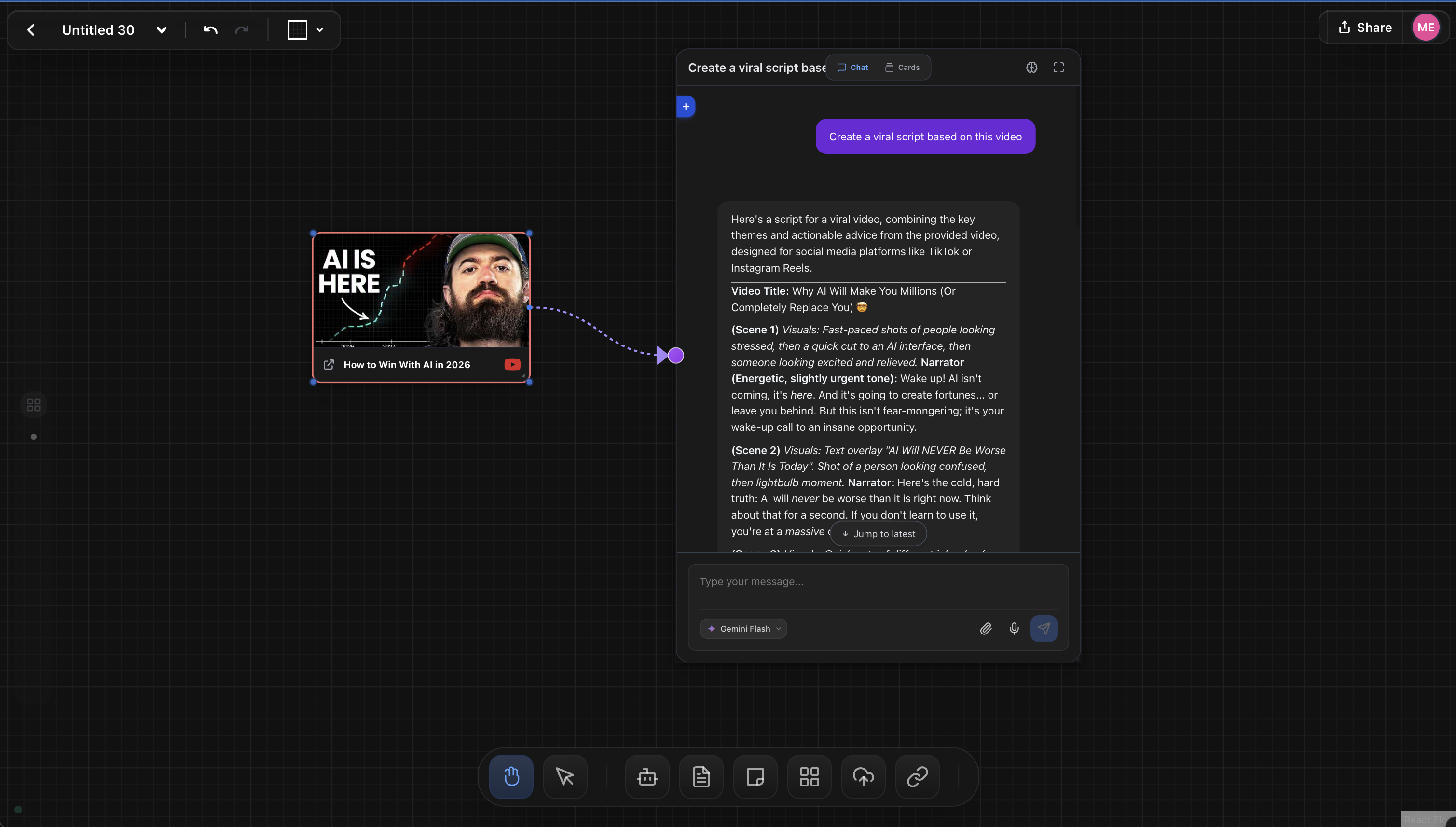
YouTube contains detailed interviews, product demonstrations, lectures, case studies, and first-person experience. It also contains repetition, sponsorship segments, unsupported claims, and hours of material that may not answer your question.
The useful unit is not the transcript. It is the evidence inside the transcript.
Begin with a comparison question
Do not start by collecting every popular video on a topic. Start with a question that allows sources to be compared.
Weak question:
What do people say about AI research?
Stronger question:
Which parts of a creator’s research workflow are consistently described as slow, and which AI-assisted steps actually reduce that work?
The stronger question gives you criteria for including or excluding a video.
Build a balanced source set
Choose videos that play different roles:
- A primary tutorial from the product or method creator.
- An independent walkthrough.
- A critical review.
- A recent interview with a practitioner.
- A high-quality older video that explains the underlying concept.
Popularity is not the same as relevance. A smaller video that directly demonstrates the workflow may be more useful than a viral overview.
Record the title, creator, publication date, URL, and why the video belongs in the set. That short note becomes valuable when the board grows.
Extract before you summarize
A general summary often removes the details that make a video useful. Ask narrower questions first:
- What process is demonstrated?
- Which inputs and tools are used?
- What result is claimed?
- Is there evidence for the result?
- What limitations does the creator mention?
- Which statements are opinion rather than observation?
If timestamps are available, preserve them. They let you return to the original context without searching the entire video again.
Compare videos side by side
Once each source has been extracted separately, compare them.
Create a table or structured note with:
| Question | Video A | Video B | Video C |
|---|---|---|---|
| Main workflow | |||
| Evidence shown | |||
| Claimed benefit | |||
| Limitation | |||
| Useful example |
This makes disagreement visible. If one creator says a workflow saves hours and another says setup takes longer than the work itself, that conflict is more useful than an average of both opinions.
Watch for transcript traps
Transcripts are convenient but imperfect. Common problems include:
- Incorrect names, numbers, and technical terms.
- Missing visual information.
- Speaker labels that are wrong or absent.
- Jokes or sarcasm interpreted literally.
- Sponsor claims mixed with editorial content.
Return to the video when a claim depends on a number, demonstration, chart, or visual comparison. The transcript can locate the moment; it should not always be treated as the complete source.
Turn the research into a brief
A useful research brief is not a pile of summaries. It should answer:
- What is the clearest conclusion?
- Which evidence supports it?
- Where do credible sources disagree?
- What remains unknown?
- Which examples should appear in the final work?
Then add a short source ledger. For each important claim, record the video and timestamp that supports it.
Prompt the model in stages
Use a sequence rather than one large request:
- “Extract the workflow, evidence, claims, and limitations from each video independently.”
- “Compare the sources and identify agreements, disagreements, and gaps.”
- “Create a brief that answers the research question. Cite the source title for each major claim.”
- “Suggest an outline for the intended audience.”
- “List anything that still requires manual verification.”
This keeps the model focused on the research before asking it to become a writer.
Stop when the answer stabilizes
More sources do not always improve the result. Stop collecting when new videos repeat the same evidence without changing the conclusion.
At that point, spend the remaining time checking the strongest claims and improving the final explanation. The purpose of AI-assisted video research is not to consume more content. It is to reach a defensible understanding with less friction.