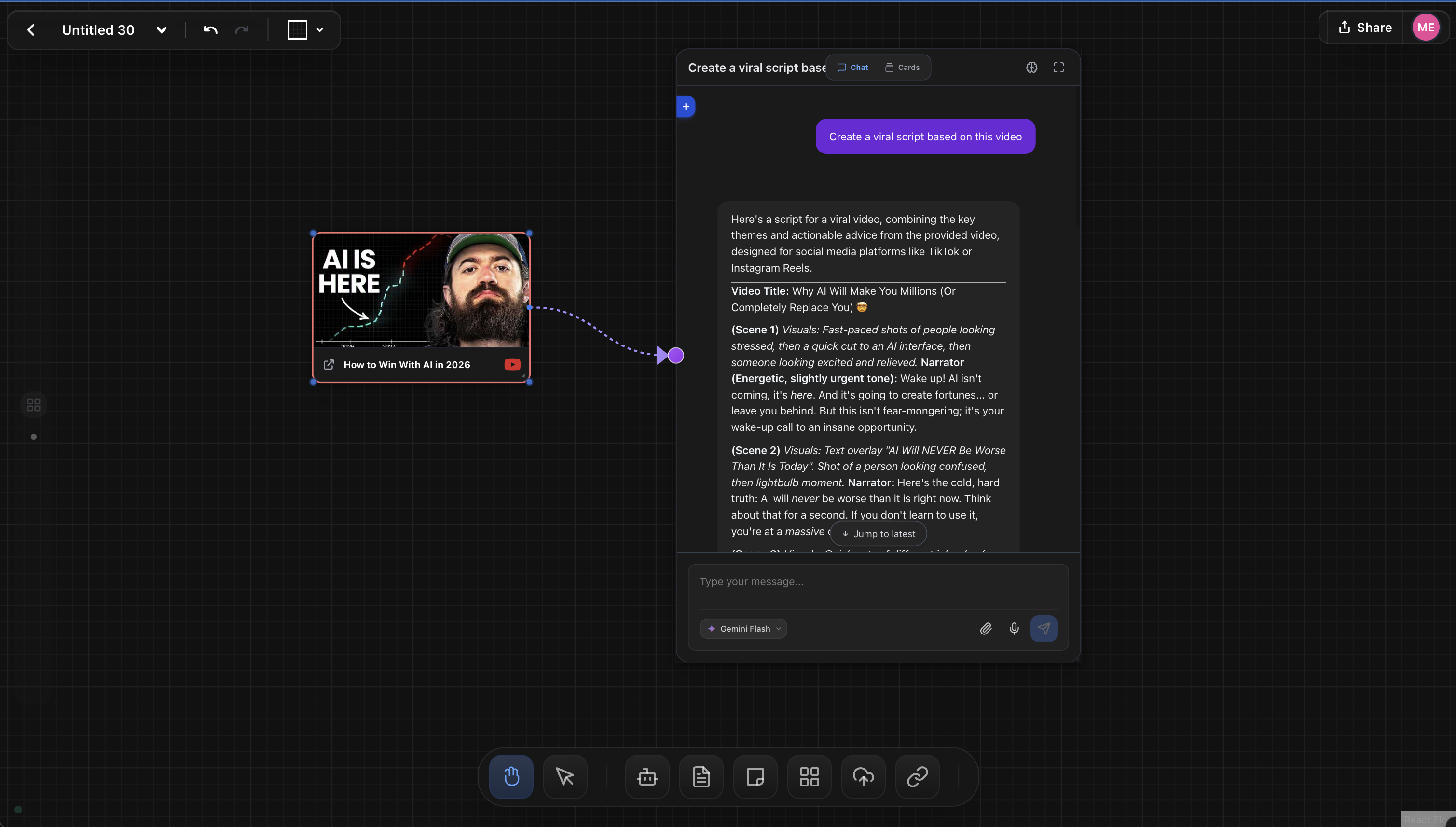
AI can produce a draft in seconds. The hard part is making sure the draft is based on the right material.
Most weak AI workflows fail before the prompt is written. The researcher has ten tabs open, a transcript in one document, notes in another, and a chat that cannot see any of it. Context gets copied in fragments. Sources become hard to trace. By the time the draft arrives, nobody remembers which claim came from where.
A source-grounded workflow fixes that by treating evidence as part of the workspace, not temporary prompt material.
What “source-grounded” actually means
Source-grounded work has three properties:
- The model receives the relevant source material.
- The person using the model can see which sources shaped the task.
- Important claims can be checked against the original material.
This does not make AI automatically correct. It makes the process easier to inspect and improve.
The goal is not to give the model everything. The goal is to give it the smallest useful set of trustworthy context.
Step 1: define the deliverable before collecting sources
Start with the thing you need to produce. “Research AI” is vague. “Create a five-minute video outline explaining why visual research workflows reduce context switching” is specific.
Write down:
- The format: article, script, brief, email, or presentation.
- The audience: who will use or read it.
- The decision: what the reader should understand or do afterward.
- The evidence standard: which claims require a primary source.
This prevents research from expanding without a stopping point.
Step 2: collect sources by role
Not every source should do the same job. Give each one a role:
- Primary evidence: original research, product documentation, filings, interviews, or direct data.
- Expert interpretation: credible analysis that explains why the evidence matters.
- Audience language: comments, forums, reviews, and interviews that reveal the words people use.
- Examples: cases that make an abstract idea concrete.
- Counterevidence: material that challenges the working thesis.
The counterevidence category is especially important. If every source agrees with your first idea, you may have built a confirmation machine rather than a research process.
Step 3: keep sources visible while you ask questions
A blank chat hides the structure of the research. A visual canvas lets you preserve it.
Place related videos, PDFs, web pages, and notes near one another. Group sources by topic or evidence type. Then connect only the material that should influence a particular conversation.
This creates a useful boundary. The chat can work from the connected context without treating every item on the board as equally relevant.
Good first questions include:
- What do these sources agree on?
- Where do they conflict?
- Which claims have direct evidence?
- What is missing for a confident conclusion?
- Which examples would be most useful to the intended audience?
These questions produce a research map before they produce prose.
Step 4: separate extraction, synthesis, and writing
Trying to do all three in one prompt makes mistakes harder to spot.
Extraction
Ask for facts, quotes, examples, and claims from each source. Keep the output close to the original material.
Synthesis
Ask the model to compare the extracted material. Identify themes, disagreements, gaps, and implications.
Writing
Only after the structure is clear should the model create the deliverable. Give it the audience, format, constraints, and desired voice.
This sequence is slower than asking for an instant article. It is much faster than repairing a polished draft built on weak context.
Step 5: run a claim-level review
Before publishing, inspect the claims that carry the argument.
For each important claim, ask:
- Is this supported by a source?
- Is the source primary or secondary?
- Does the source say exactly what the draft implies?
- Is the information current?
- Is uncertainty represented honestly?
Then check the output as a human reader. A grounded draft can still be confusing, repetitive, or poorly framed.
A reusable prompt sequence
You can adapt this sequence to most research-heavy content:
- “Summarize each connected source separately. Do not combine them yet.”
- “List the strongest agreements, conflicts, and missing evidence.”
- “Propose three angles for the intended audience. Explain the evidence behind each.”
- “Build an outline using only claims supported by the connected sources.”
- “Draft the piece. Mark any sentence that needs additional verification.”
- “Audit the draft for unsupported claims, weak transitions, and repeated ideas.”
The important part is not the exact wording. It is the separation of tasks.
The system is the advantage
Models will keep changing. A durable research system should not depend on one model having a perfect day.
Keep the sources visible. Make context intentional. Separate extraction from synthesis. Review the claims that matter. When those habits are built into the workspace, AI becomes easier to direct and its output becomes easier to trust.