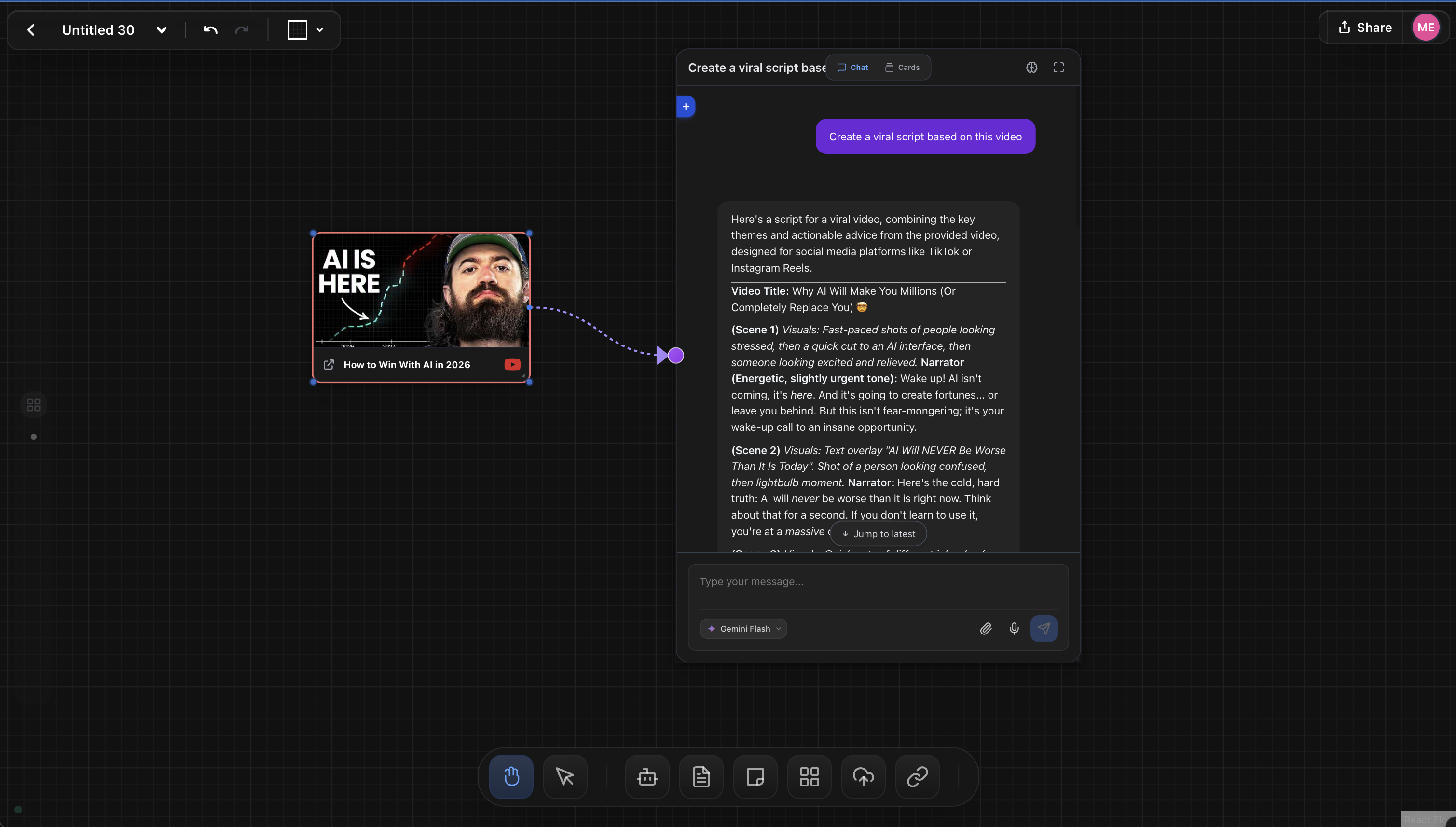
A blank AI chat is excellent when the task fits inside one conversation. Ask a question, provide context, receive an answer.
The experience becomes harder when the work involves many sources, several deliverables, or decisions that need to stay visible. Context gets buried in message history. Files become attachments with unclear roles. A second conversation starts from zero.
An AI canvas gives the work a spatial structure.
The basic idea
An AI canvas combines a visual workspace with model-powered conversations. The canvas can hold source material, notes, documents, groups, and chats. Connections between items indicate which context belongs to which task.
Instead of asking one conversation to remember an entire project, you can organize the project and bring relevant context to the conversation that needs it.
The canvas does not replace the model. It changes how people prepare, inspect, and reuse context.
Where a canvas helps
Multi-source research
When a project includes videos, PDFs, web pages, screenshots, and notes, a canvas can keep the evidence visible. Related sources can be grouped. Conflicting sources can be placed side by side. A chat can be connected to the subset that matters.
Content development
A creator can keep research, hooks, outlines, examples, and drafts on the same board. The path from source to deliverable becomes easier to follow.
Comparing model output
Different models can be asked to work from the same context. Their answers can be compared without recreating the research package each time.
Long-running projects
The workspace preserves structure between sessions. A new conversation does not need to begin with a long explanation of where everything lives.
When a blank chat is better
A canvas adds structure, and structure has a cost. Use a normal chat when:
- The question is simple and self-contained.
- You need a fast explanation, rewrite, or calculation.
- The source material fits comfortably in one message.
- You will not need to reuse the context.
The goal is not to put every task on a board. It is to match the interface to the complexity of the work.
Connections are context decisions
The most important part of an AI canvas is not the line animation or node style. It is what a connection means.
A useful connection answers: “Should this item influence that conversation?”
That makes context selection explicit. If a chat is connected to a customer interview, a product document, and a research paper, those sources form the working evidence set. An unrelated note elsewhere on the board does not need to enter the prompt.
Explicit context reduces two common problems:
- Context overload: too much material dilutes the task.
- Context ambiguity: nobody knows which sources shaped the answer.
Groups create reusable research packages
Groups or folders can represent topics, campaigns, customers, or stages of work. A group might contain:
- Five competitor landing pages.
- Three customer interviews.
- A positioning brief.
- A note containing open questions.
Minimizing the group keeps the board clean without discarding its contents. Reopening it restores the working set.
This is especially useful when one board contains several related but distinct research areas.
A practical example
Imagine you are creating a video about a new software category.
On a blank chat, you might paste several links, add transcript excerpts, explain the audience, ask for an outline, and then repeat the process when you start the script.
On a canvas, you can:
- Add the primary product pages and documentation.
- Add independent reviews and customer language.
- Group the material by evidence type.
- Connect the relevant sources to a research chat.
- Create a brief.
- Connect the brief and strongest sources to a writing chat.
- Draft the script while the evidence remains visible.
The advantage is not that the model writes faster. The advantage is that the research structure survives the transition from question to deliverable.
Evaluate the workflow, not the screenshot
Visual workspaces can look impressive before they become useful. Test an AI canvas with a real project and ask:
- Can I tell which sources influence the answer?
- Can I reorganize the board without breaking the work?
- Can I return later and understand the structure?
- Can I move from research to a deliverable without rebuilding context?
- Can I verify important claims?
If the answer is yes, the canvas is doing more than arranging boxes. It is making the reasoning process easier to manage.